 English
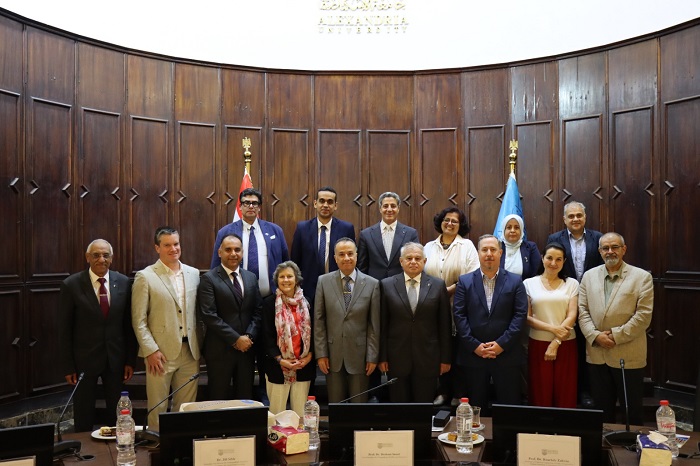
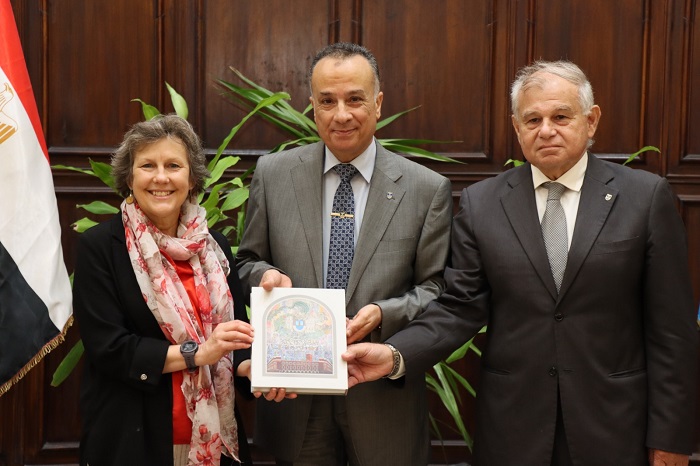
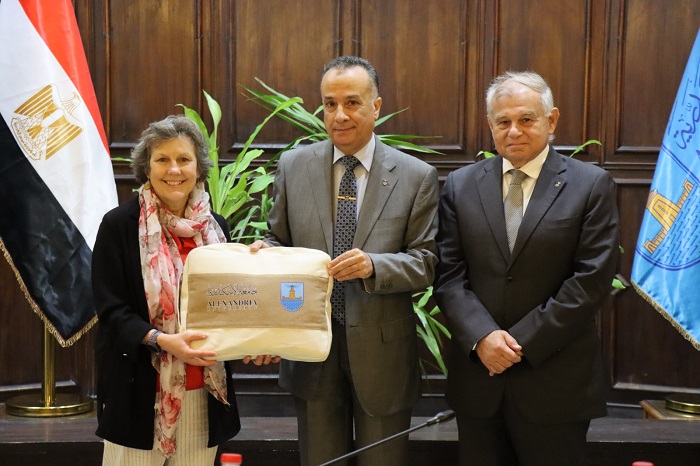
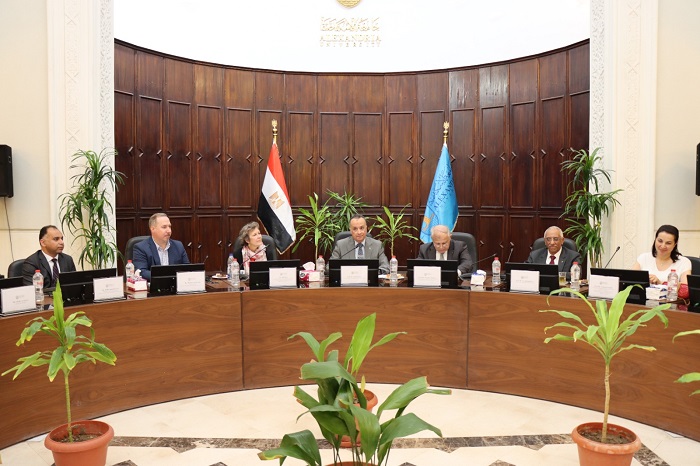
As part of the ongoing visit of a delegation from Virginia Tech to Alexandria University, and under the auspices of Professor Dr. Ahmed Adel Abdel Hakim, Acting President of Alexandria University, the University organized a joint workshop to review the latest developments regarding the establishment of Virginia Tech’s international branch on Alexandria University’s campus in Borg El Arab.
The workshop also explored opportunities to strengthen cooperation in joint academic programs, emerging technologies, innovation, and the integration of scientific research with industry through Alexandria University’s Technology Valley.
The workshop was attended by Professor Dr. Hesham Saeed, Vice President for Graduate Studies and Research; Professor Dr. Roshdy Zahran, Former President of Alexandria University and Rapporteur of the Higher Committee for Technology Valley Strategies and Policies; Professor Dr. Ali Abdel Mohsen, Supervisor of the International Relations Office; Professor Dr. Gihan Jouifil, Assistant President for Internationalization and International Branches; Professor Dr. Wael El-Maghlani, Acting Dean of the Faculty of Engineering; along with a number of university leaders and faculty members, in addition to the Virginia Tech delegation.
The American delegation included Dr. Jill Sible, Associate Vice Provost for Undergraduate Education and Director of the Academy of Experiential Learning; Dr. Thomas Archibald, Executive Director of the Center for International Research, Education, and Development (CIRED); Dr. Mohamed Siam, Director of Experiential Learning and Associate Professor of Computer Science; Mr. Dennis Goinette, Former Director of Laboratories; and Dr. Khaled Hassouna, Associate Director for Middle East and North Africa Initiatives and Curriculum Development at CIRED.
During his remarks, Professor Dr. Hesham Saeed welcomed the Virginia Tech delegation and reaffirmed Alexandria University’s commitment to international expansion and the establishment of strategic partnerships with globally distinguished universities, aiming to enhance the competitiveness of its graduates and improve the quality of education and research.
He reviewed the longstanding cooperation between the two institutions in several engineering and technical programs, noting that Alexandria University continues to expand its portfolio of joint academic programs and international degrees, while also hosting branches of international universities at its Borg El Arab campus. These efforts are part of a comprehensive strategy to internationalize higher education and position the University as a regional hub for advanced educational services.
Professor Dr. Hesham Saeed also highlighted the University’s efforts to establish a world-class Technology Valley that will accelerate knowledge transfer between academia and industry, foster innovation and entrepreneurship, and provide the necessary infrastructure for startups, small and medium-sized enterprises, thereby transforming research outcomes into economic and developmental value.
Professor Dr. Roshdy Zahran emphasized that Alexandria University is one of Egypt’s oldest higher education institutions and possesses a distinguished academic and research legacy. He noted that the Technology Valley represents a strategic project aimed at supporting the knowledge economy by linking scientific research outputs with industry and transforming innovations into products with added economic value. He added that this approach contributes to the establishment of companies based on research outcomes and scientific ideas developed within the University, thereby enhancing economic competitiveness and promoting innovation and entrepreneurship in line with Egypt’s sustainable development goals and future vision.
For her part, Dr. Jill Sible expressed her appreciation for the collaboration with Alexandria University, praising its status as one of Egypt’s most prestigious universities and highlighting its strong research capabilities and industry-oriented initiatives that address societal challenges through scientific research. She reaffirmed Virginia Tech’s commitment to strengthening cooperation in scientific research, experiential learning, and knowledge transfer, particularly within the framework of the Technology Valley.
The workshop addressed mechanisms for supporting and developing the Technology Valley and enhancing its role in fostering startups. Participants reviewed international best practices in technology transfer, commercialization of research outputs, and industry engagement. Discussions also covered ways to support researchers in developing innovative ideas, evaluating patent opportunities, and documenting innovations at early stages to facilitate their commercialization and transfer.
The Alexandria University team also delivered a presentation outlining the key features of the Technology Valley project, in addition to a presentation on its medical component, reflecting the integration of various research and applied sectors within the initiative.